The Liquidation Sale: the claims, checked
Every claim in the video, mapped to its source. The figures come from the BC government's own reports and from published reporting. They are here so you can check them.
The target
Premier David Eby's mandate letter to Forests Minister Ravi Parmar, dated January 16 2025, directs the minister to work toward "a sustainable land base to enable harvest of 45,000,000 cubic metres per year, while fulfilling our commitment to protect old growth."
Office of the Premier, Mandate Letter to the Hon. Ravi Parmar, Jan 16 2025.
An increase of 40 percent
BC's 2024 Crown harvest was about 32 million cubic metres. A 45 million target is 40.6 percent above that. The mandate applies to Crown land, so the Crown-only figure is the like-for-like baseline. Premier Eby has separately described the direction as raising logging "by roughly 50 per cent compared to 2024"; 40 percent is the more conservative figure.
Harvest figures via Business in Vancouver; direction described in The Narwhal, Nov 12 2025.
Where the number came from
David Elstone, a forestry consultant at Spar Tree Group, proposed a target of 45 to 50 million cubic metres in an op-ed on October 3 2024. The BC election was October 19 2024, sixteen days later. In his own words the number was "an aspirational goal" and "a signal to investors," not the output of a Chief Forester's carrying-capacity analysis. It was then written into the Premier's January 2025 mandate letter.
Elstone op-ed, Spar Tree Group, Oct 3 2024; mandate coverage in The Narwhal, Jan 22 2025.
The forests are too young
About 80 percent of BC's replanted forests are under 40 years old. Merchantable rotation ages in BC commonly run 70 to 120 years depending on species, site, and region, so plantations under 40 years cannot be harvested in the timeframe a current-year target requires.
The Tyee, "Are BC's Forests Running Out of Trees?" Sept 11 2024, citing Ministry of Forests figures.
Fire losses exceed the models
BC's long-term average annual burn area is about 183,000 hectares. In 2023 about 2.84 million hectares burned, roughly 15 times the average in one year. Timber Supply Review models carry fire-loss assumptions well below recent experience: in the Mackenzie timber supply area the 2023 review assumed a few hundred hectares of harvestable forest burning per year, while a leaked analysis reports about 50,000 hectares of harvestable timber burned there in 2023.
Wildfire totals: BC Ministry of Forests, Forest Analysis and Inventory Branch. Mackenzie analysis reported by Castanet, Nov 19 2025.
Protecting old growth would cut the harvest by 29 percent
The BC government's own analysis of fully protecting the 2.6 million hectares of at-risk old growth identified by the independent Technical Advisory Panel estimated that full protection would reduce the allowable cut by about 29 percent. The figure is the government's own.
BC Gov News, "Old-growth logging declines to record lows," Nov 2 2022 (the 29 percent estimate appears in the body).
Deferral areas logged four times harder
A November 2025 analysis by Karen Price and Dave Daust, both original members of BC's Old Growth Strategic Review panel, using Ministry of Forests data, found BC forests were about four times more likely to be logged inside recommended deferral zones than outside over the previous four years.
Reported by Prince George Daily News, Nov 19 2025; source report from Sierra Club BC.
Parks floated for logging
At the Council of Forest Industries convention in Prince George in April 2025, Forests Minister Ravi Parmar suggested provincial parks and Old Growth Management Areas could be opened to logging for "wildfire resilience." Both classes of land have historically been excluded from commercial harvest. Conservation groups called it a "timber grab."
Prince George Daily News, Apr 8 2025.
The price of burning fire-killed wood was cut
Effective April 1 2024, the Ministry of Forests revised its Interior Appraisal Manual to reduce stumpage (the price industry pays the Crown per cubic metre) on wildfire-damaged timber, to make salvage "more economic for businesses." About 1.1 million cubic metres of interior wildfire salvage was harvested in 2024.
BC Gov News, "Wildfire-damaged wood recovery underway," Apr 10 2024; Canadian Biomass, Apr 11 2024.
The mills are closing
More than twenty permanent or indefinite mill closures have hit BC since 2023, including three major operations in 2025 (Crofton pulp, 100 Mile House sawmill, Williams Lake pellet). The allowable-cut ceiling has been declining for over a decade, and BC's own budget projects Crown harvest falling to about 29 million cubic metres by 2027/28, below the 45 million target.
On the ground
If logging has affected you or a place you love, write a testimonial. Every account helps show what the numbers above look like on the ground.
There is also a petition for a new Minister of Forests and a public inquiry into BC's timber estimates: savewhatsleft.ca/petition.
Cai Creek: the math
Every figure in the reel, with the math and the source. They are here so you can check them.
The block
The cutblock is TA2185-3, 50.9 hectares, about 7.8 kilometres from Castlegar. BC Timber Sales auctioned it, and the Sutherland Group holds the permit.
Block reference, area, and permit status from BC's public cutblock records, mirrored on Cutblock Watch. Type TA2185-3 to pull the block and its map file.
The forest
Cai Creek is a largely intact old-growth watershed, assessed at 70 to 80 percent intact. Field surveys record veteran fir, cedar, and pine estimated at 250 to 400 years. The largest ponderosa pine in British Columbia stands here, and it is protected, along with every tree within a 56 metre radius of it, about one hectare. The other roughly fifty hectares are not.
Intactness: Old Growth Technical Advisory Panel assessment. Tree ages: savecaicreek.com field surveys. Protected tree and buffer: Special Tree Protection Regulation, BC Reg 229/2020.
What the public gets for it
The whole TA2185 sale was appraised at 31,975 cubic metres at $133.50 per cubic metre, about $4.27 million to the province, or 76 cents for each British Columbian, once. The Cai Creek block is about $1.7 million of that, roughly 31 cents each.
The block figure is apportioned by area from the whole-sale total, because the province publishes stumpage per sale, not per block. Stumpage is pay-as-cut, so it is collected only if the wood is cut. At $133.50 the rate is among the highest of BC's 10,148 timber marks, where the median is $19.33.
Rate and volume: BC's public Harvest Billing System, timber mark TA2185. Population: BC Stats.
What the logs earn
The reel puts the profit on the logs at about 40 thousand dollars. Selling the wood covers two things: the $1.75 million in stumpage bid to the province, and about $854,000 to harvest it, haul it, and build the road. At average interior log prices that is roughly what the logs are worth, so they mostly just pay for the cost of cutting them, with little or no profit left.
The road, haul, and harvesting money is the part that does not depend on the log price. The Sutherland Group does that work with its own crews and trucks, so that $854,000 is paid back into its own divisions either way.
Volumes and stumpage: Harvest Billing System. Log prices: BC Interior Log Market Report, Oct–Dec 2025. Cost stack from the Interior Appraisal Manual.
Nobody is required to cut it
A licence is permission to cut, not an instruction to cut. Because stumpage is pay-as-cut, wood left standing costs the licence holder nothing. The permit can lapse or be surrendered.
BC Timber Sales Regulation.
Is it worth it?
Every figure in the video, with the math and the source. All numbers come from the BC government's own published reports. They are here so you can check them.
What the public nets from logging
In the most recent audited year (2024/25), logging on BC's public land paid the province $507 million. Running the forest program cost $418 million. The difference left for the public is $89 million, about $15 per British Columbian.
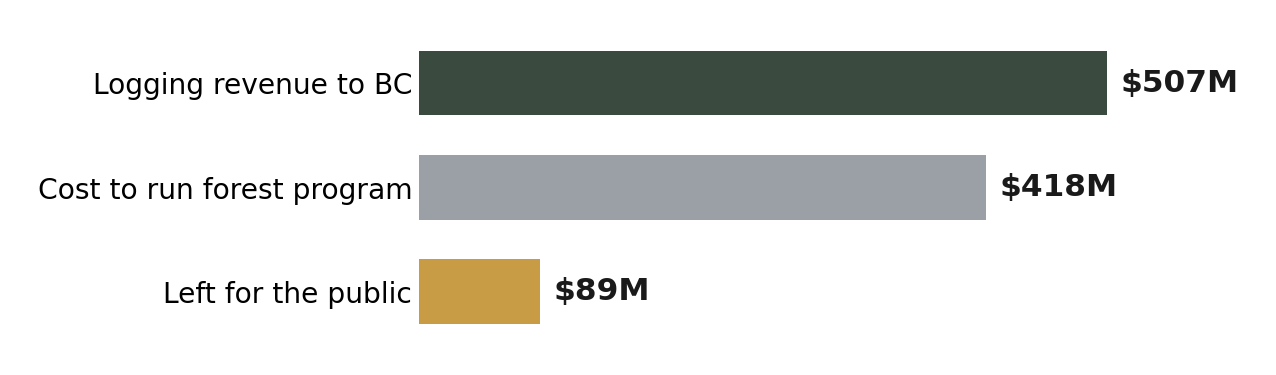
Two items are set aside so revenue and cost compare like for like: wildfire response ($769M) and BC Timber Sales, the timber-auction branch ($213M, which roughly breaks even after its replanting and road costs). What's left is the general forest program.
Revenue: 2024 Economic State of BC's Forest Sector, Fig. 27 (= BC Budget Table A5). Cost: Ministry of Forests 2024/25 Annual Service Plan Report, p.25 ($1,400M operating − $769M wildfire − $213M BC Timber Sales).
One World Cup match costs more
BC will host seven FIFA World Cup matches at BC Place. The province estimates BC's total hosting cost at $685–729 million, or about $98–104 million per match. One match costs more than a full year's net public return from logging.
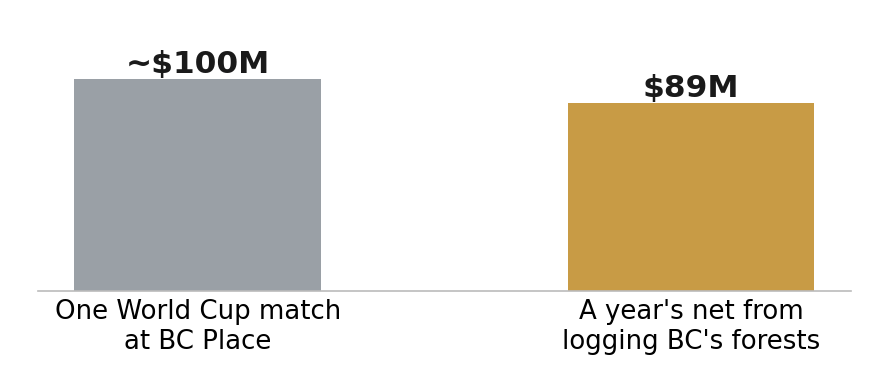
Province of BC cost update, May 2026: CBC; Business in Vancouver.
Revenue is falling, and forecast flat
Forest revenue to the province fell from $1.9 billion in 2021/22 to $507 million in 2024/25. The government's own forecast holds it near $507 million through 2027/28.
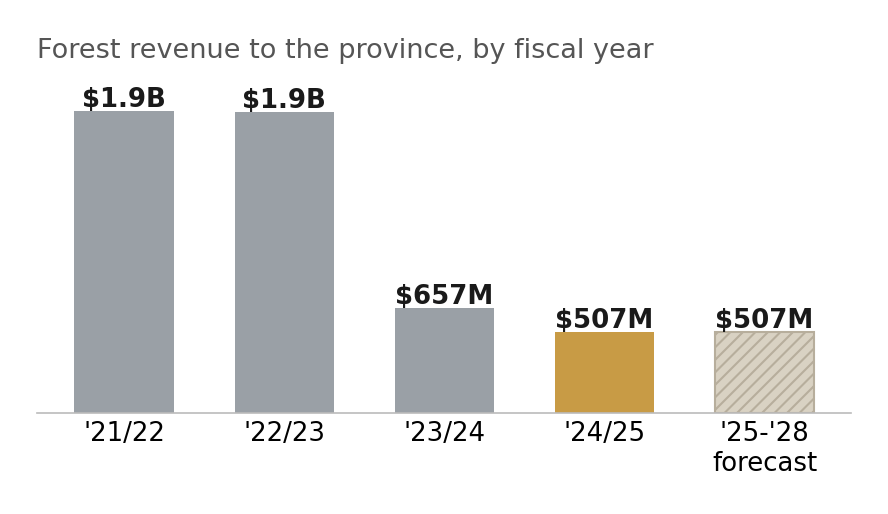
2024 Economic State of BC's Forest Sector, revenue table and Fig. 27 forecast note.
How forestry compares to oil, gas, and mining
Forestry is not BC's only public resource. In the same year, natural gas royalties brought in about $573 million and mining about $548 million. Forestry's stumpage was a similar size, about $507 million, but almost all of it went back into running the forest program, leaving $89 million. The gas and mineral figures are royalties and taxes the province largely keeps. Forestry is the one big resource where the public spends nearly as much managing the cut as it collects.
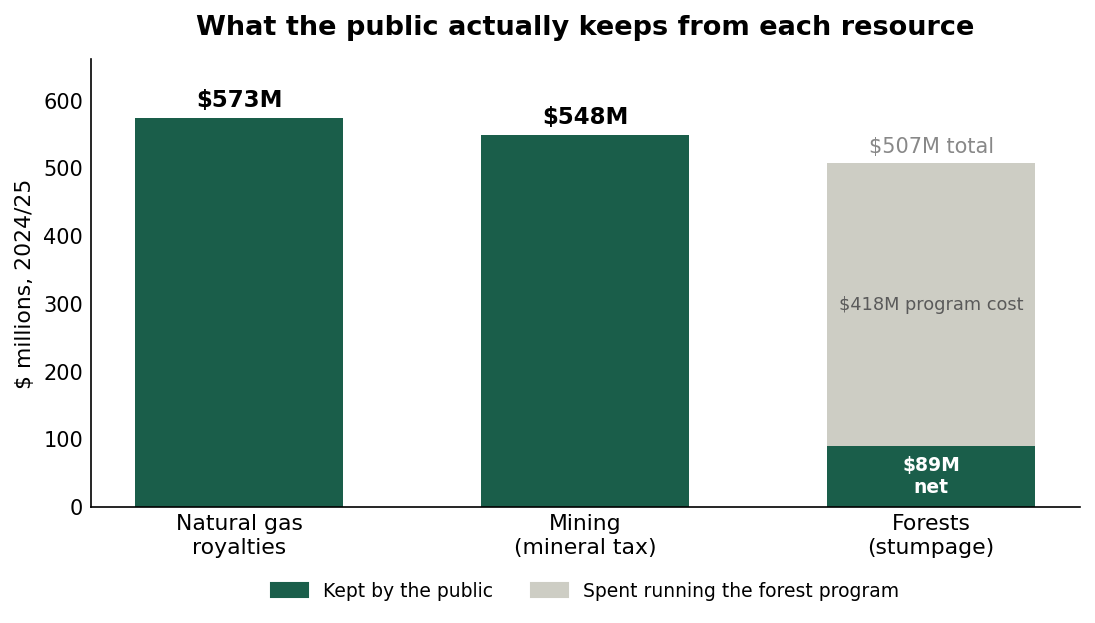
Natural gas royalties, after deductions: BC Fall 2024 Economic & Fiscal Update. Mining: BC Budget 2024 estimate. Gas and mineral royalties are collected with far less public administration relative to revenue (the BC Energy Regulator is funded by industry levies, not netted here), which is why forestry's net return stands out.
The plan is to cut more
The Premier's January 2025 mandate letter directs the Forests Minister to enable a harvest of 45 million cubic metres a year. Recent harvests were about 32 million m³ (2025) and 39 million m³ (2024). The target is roughly 15 percent above the 2024 cut, or about 40 percent above the lower 2025 cut.
Forests Minister mandate letter, January 16 2025; recent harvest via Business in Vancouver and the Annual Service Plan Report.
The scale
BC's 15-year average harvest is about 180,000 hectares a year. A regulation soccer pitch is 0.71 hectares (105 m × 68 m). That works out to about 252,000 soccer fields of forest cut every year.
Harvest area: BC Environmental Reporting (Ministry of Forests), 15-year average. Pitch size: FIFA Stadium Requirements.
What isn't on the ledger
Logging has touched a lot of British Columbians directly. Tell me how it has affected you, and help keep this work going.
There is also a petition for a new Minister of Forests and a public inquiry into BC's timber estimates: savewhatsleft.ca/petition.
Rosebud: the math
Every figure in the documentary, with the math and the source. They are here so you can check them.
The plan
BC Timber Sales' Forest Operations Map 2153 covers 77.5 hectares of clearcut across three cutblocks near Rosebud, in BC's Central Kootenay. 64.4 hectares fall inside the Eldorado Creek watershed, about 8 percent of the watershed itself. 5 kilometres of new Forest Service Road is approved.
BCTS Forest Operations Map 2153: fom.nrs.gov.bc.ca/public/projects/2153.
Who lives there
The Eldorado Creek watershed is the drinking-water supply for about 25 households near Nelway, on Highway 6 north of the Canada-US border. The watershed is karst, limestone bedrock with springs that drain quickly to surface streams. Loss of forest cover translates directly to drying of those springs.
Nelson Star, April 23 2026; My Nelson Now.
What the community said
On April 16, 2026, the Regional District of Central Kootenay board voted unanimously to write the province asking for ecological-reserve designation for the Rosebud and Lomond Creek watersheds. BCTS is proceeding with road construction anyway.
What this costs the public
BC Timber Sales itself reports a small annual surplus on paper. In FY 2024/25, gross revenue was about $240 million against rising expenses, leaving a net surplus of $27.6 million. The agency also carries $166.7 million in deferred reforestation liabilities, the replanting work owed but not yet funded. That is roughly six years of surpluses owed.
The bigger ministry-wide cost is fire. With the Fire Management bar removed, forest revenue and forest spending land within $55–115 million of each other in recent audited years.
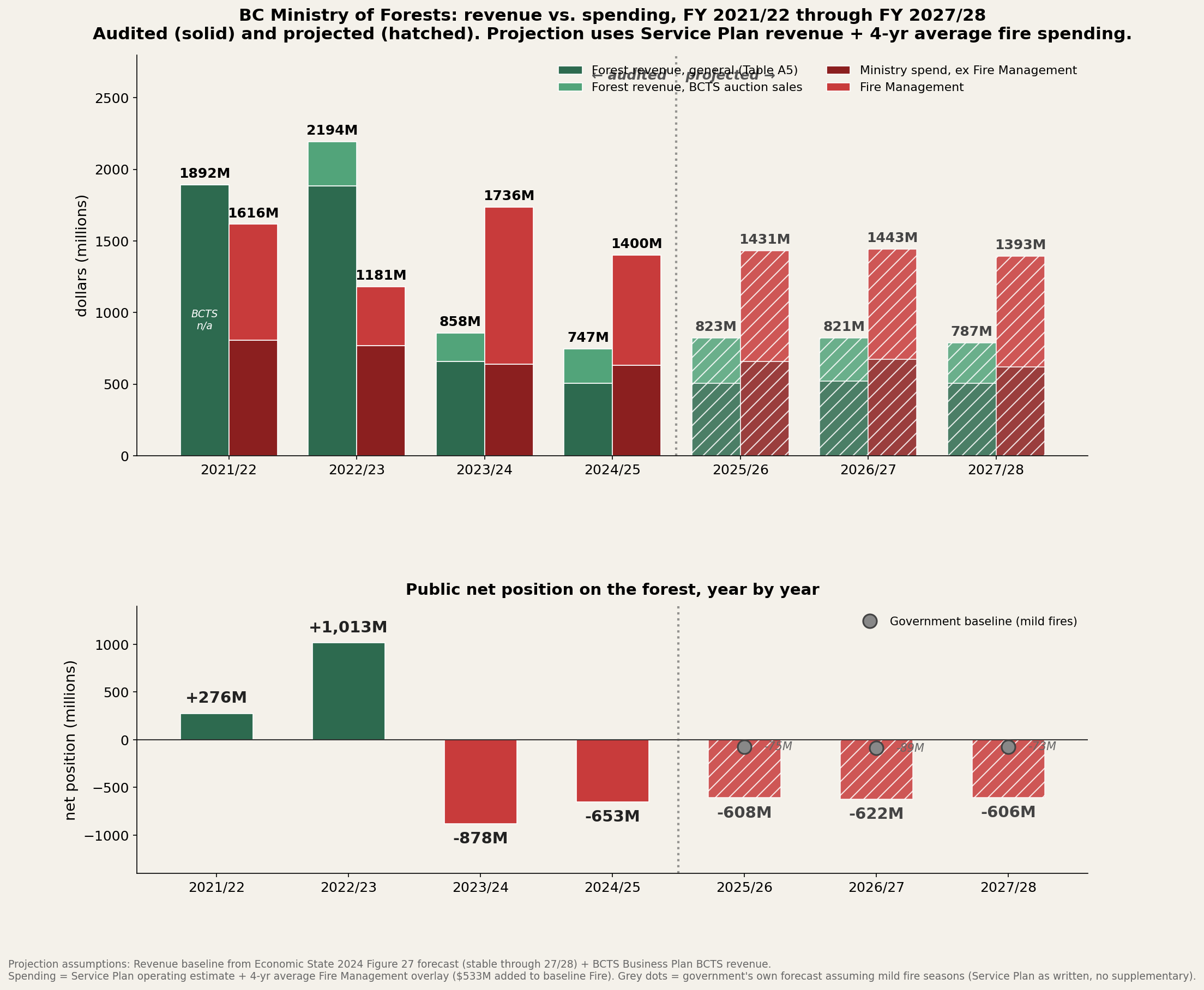
The shortfall the headlines describe is the wildfire line, not the logging line.
BCTS financials: BCTS Annual Public Performance Report 2024/25. Ministry totals: Ministry of Forests 2024/25 Annual Service Plan Report; revenue forecast: 2024 Economic State of BC's Forest Sector.
What's next
March 30, 2026: legislative amendments expand BCTS allowable harvest by 800,000 cubic metres a year, roughly 17,700 truck loads. 2024 Southern Interior BCTS volume, which includes the Selkirk District where FOM 2153 sits, was up 55.5 percent year-to-date.
BC government release on BCTS amendments: news.gov.bc.ca/releases/2026FOR0009-000335.
Sooke vs Rosebud: the math
Every figure in the reel, with the math and the source. They are here so you can check them.
What Sooke has
The Sooke Lake watershed is the primary drinking-water supply for about 350,000 people in Greater Victoria. The Capital Regional District owns the surrounding land outright. There has been no commercial logging in the catchment area since the early 1900s, after documented sediment damage.
CRD Sooke Water Supply Area; Timeline of the Greater Victoria Water System.
What it cost to keep it that way
In September 2025, the Capital Regional District spent $33.3 million to purchase 1,973 hectares from Kapoor Lumber Company, retiring the last logging tenure inside the watershed. The bill is paid by water-rate payers across Greater Victoria, about $14 per household per year, not by provincial taxpayers.
CRD news release; CRD loan-authorization bylaw; Times Colonist.
What Rosebud has
The Eldorado Creek watershed near Rosebud is the drinking-water supply for about 25 households near Nelway, BC, on Highway 6 north of the Canada-US border. The watershed is karst, limestone bedrock with springs that drain quickly. On April 16, 2026, the Regional District of Central Kootenay voted unanimously to ask the province for ecological-reserve designation for the Rosebud and Lomond watersheds.
Nelson Star, April 23 2026; Castanet.
What's planned for it
BC Timber Sales' Forest Operations Map 2153 covers 77.5 hectares of clearcut across three cutblocks. 64.4 hectares falls inside the Eldorado Creek watershed, about 8 percent of the watershed itself. 5 kilometres of new Forest Service Road is approved. BCTS is moving forward with construction.
BCTS Forest Operations Map 2153; BC Government release.
What it costs the public
BC Timber Sales itself reports a small annual surplus on paper. In FY 2024/25, gross revenue was about $240 million against rising expenses, leaving a net surplus of $27.6 million. The agency also carries $166.7 million in deferred reforestation liabilities, the replanting work owed but not yet funded. That is roughly six years of surpluses owed.
The bigger ministry-wide cost is fire. With the Fire Management bar removed, forest revenue and forest spending land within $55–115 million of each other in recent audited years. The shortfall the headlines describe is the wildfire line, not the logging line.
BCTS financials: BCTS Annual Public Performance Report 2024/25. Ministry totals: Ministry of Forests 2024/25 Annual Service Plan Report; 2024 Economic State of BC's Forest Sector.